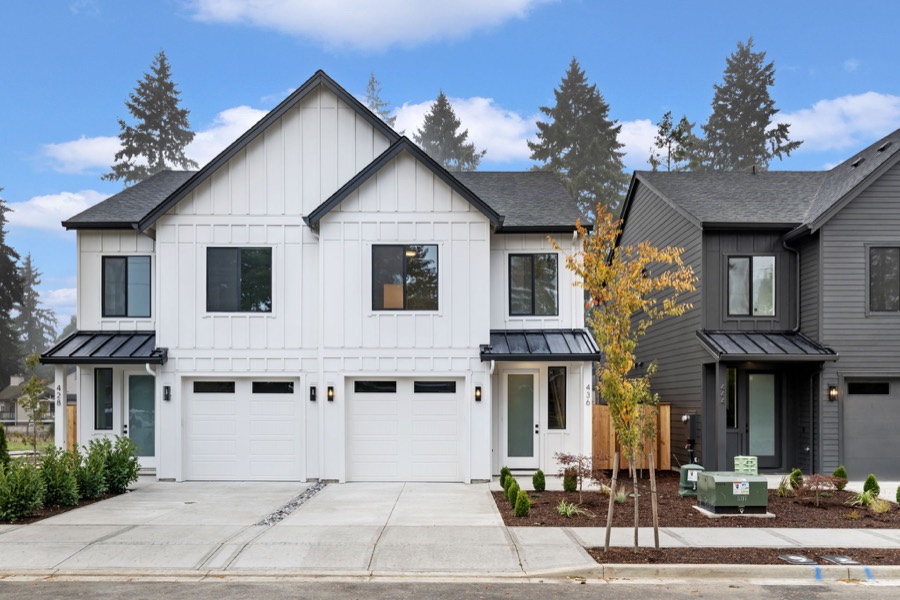
Arthur · 114 units
Location: Vancouver, WA
Farragut, Kenton, Ashley, Fircrest, Livingstone
Watch this project’s journey:
InstagramSee more on this project:
View the projectNumbers & Deals · Ruben the Builder · 11K views
The underwriting formula behind every project: reverse-engineer from sale price, cap the land cost, and only break ground at 20%+ ROI.
Full guide: Numbers & Deals →Underwriting is the skill that separates developers from dreamers, and it’s a formula, not rocket science.
Sale price minus construction minus land equals gross profit. Work it backwards: start from what the finished product sells for today, subtract what it costs to build, and what’s left is the most you can pay for land while keeping your margin. Land at 20-25% of the final value or less. Minimum 20% ROI, 25% for safety.
The developer’s formula: sale price minus land, construction, and ~3% selling costs. Investment build assumes ~10% down + closing.
$162,000
Est. profit
29%
ROI on cost
25%
Land % of sale
212%
Cash-on-cash
Rules of thumb from the BuildUp playbook: land at 20-25% of sale price or less, and a minimum 20% ROI (target 25%) before breaking ground. Red numbers mean the deal doesn’t pencil yet. Estimates only, not financial advice.
Good underwriting is adversarial. Push your sale comp down, push your construction number up, add a contingency, and see if the deal still clears 20%. If it only works with optimistic numbers, it doesn’t work. There is always another lot; remember the ratio of 1 viable deal per 20-50 evaluated.
Ask builders for $/sqft ranges on the product type you're targeting, and sanity-check against recent local builds. Your first ghost deals will be rough; by the tenth they'll be sharp.
Land priced above 25% of the finished value. Unless something unusual is true, the margin is already gone at purchase.
Ready to stop watching and start building?
Join the BuildUp Challenge and book a call with our team.
Join the BuildUp ChallengeWatch more on Ruben's channel.
The land can never cost more than 20% of the final build value. On a $1 million home that is $200,000; on a $500,000 home it is $100,000. It is a ceiling, not a target, and paying less is pure additional profit. Break this at step one and the deal is lost before anything is built.
Buildable, comps, and cost per square foot, in that order. If the utilities are not there, nothing else matters. If the comps are wrong, every number downstream is wrong. Cost per square foot only becomes meaningful once the first two check out.
Think like an appraiser, who is only looking at available data. Compare square footage, bedroom and bathroom count, lot size, year built, and amenities. Pull about five sold properties into a spreadsheet in columns and look for the differences that explain the price gaps. If several land within a percent or two of each other, that is your number.
Because your project carries no risk for him. When he builds his own spec, he takes the loan and pays the interest, which on a $500,000 house is roughly $50,000 a year of carrying cost. On your project he has no loan, no interest, and no risk. He project-manages with subs he already uses and keeps the fee. Ten of those a year is real revenue on existing overhead.
Several ways, and Ruben has never found a market without one. Look up the listing agent on sold new construction and ask for an introduction. Pull permit records. Ask subcontractors who they build for. Drive active job sites. Ask wholesalers. Spec builders are visible by definition, because their finished houses are listed publicly.
Nationwide
65+ active member builds, 300+ units in progress, across 20+ states. Click a market to see who is building there.
346
Units developing live
49
Markets
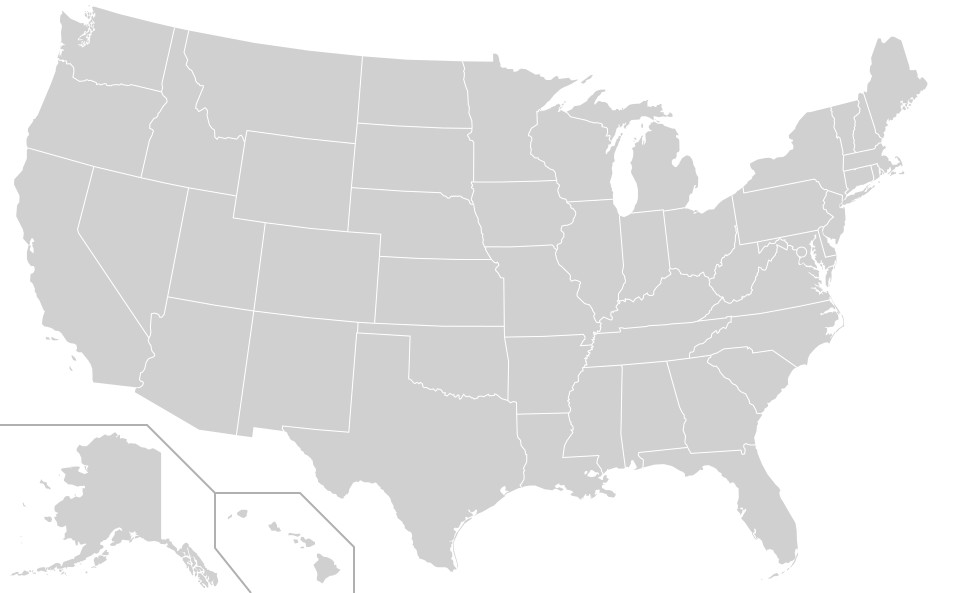
Location: Vancouver, WA
Farragut, Kenton, Ashley, Fircrest, Livingstone
Watch this project’s journey:
InstagramSee more on this project:
View the projectClick this market again for the next build here.
Your next step
New to development
A step-by-step challenge to line up your first deal, with our team beside you.
Join the ChallengeLive every week
Arthur and Ruben break down real deals and answer your questions in a live Q&A.
Join the live masterclassReady to build
Development consulting for people ready to put a real deal together now.
Explore consultingFree Resources
The templates, guides, and live sessions we hand every new member.
Real 2026 build costs for 43 US markets, from Arthur's own price map, with a live profit calculator.
Explore →Free PDFThe complete roadmap from land to sale, free.
Get it →Free AccessFree resources and every member story in one place.
Get it →Live WeeklyLive masterclass, weekly on Tuesdays. How to become a developer even with zero construction experience.
Get it →Free TemplateThe letter we use to reach lot owners directly, plus the training to use it.
Get it →Starter KitEverything you need to get moving on your first development, in one place.
Get it →Free CourseOur full 2.5-hour course on becoming a developer, land to exit, free on YouTube.
Get it →