Arthur · 114 units
Location: Vancouver, WA
Farragut, Kenton, Ashley, Fircrest, Livingstone
Watch this project’s journey:
InstagramSee more on this project:
View the projectLarger Projects · Arthur the Developer
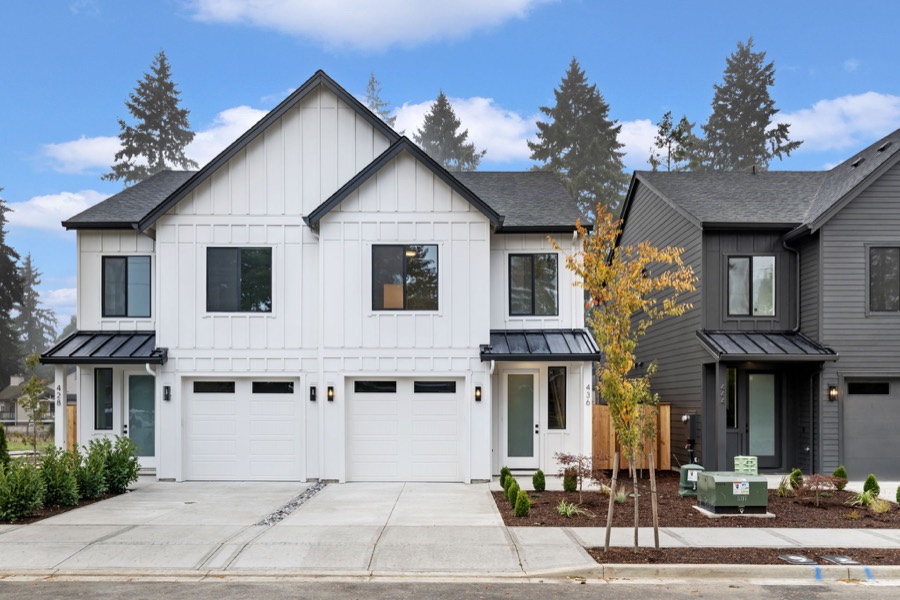
A walkthrough of 4 newly built duplexes and what it takes to run 8 units at once as a developer.
Full guide: Larger Projects →Phase one at Fircrest is eight units, four duplex buildings, and they are at four different stages at once. Two buildings are in finish work, two are in framing about 45 days behind. This is what sequencing a multi-building project actually looks like, plus the real cost numbers.
The first building mixes lap siding with board and batten for a more modern read, finished black on the lap and white on the batten. The second goes full farmhouse: light colors outside, lighter cabinets inside, warmer overall. The first will get green tile and wood cabinets on the interior instead. Metal roofs on both, which is a standing priority.
Siding finishes, then gutters get scheduled immediately, then all the exterior flatwork gets poured, then the whole building is painted, then landscaping starts. The order is not arbitrary, and the urgency is: the interior is moving fast, so the exterior has to catch up rather than become the thing holding up a listing.
Drywall is textured, in the garages too. Finish carpentry material, doors and trim, arrives right away and installers start on doors. Flooring and cabinets go in, and on the day flooring is installed it gets covered with a thin protective board so nothing drags across it.
What is left is countertops, then plumbing, electrical, and HVAC finishes, which take a few days, then paint, which takes 4 to 5 days and is the actual long pole. Two to four weeks to done.
Oak cabinets downstairs with gold handles, black countertops, and a green tile backsplash wrapped vertically at the window. Black shaker cabinets upstairs to change the feel between floors. LVP in the laundry and water heater area with carpet in the bedrooms, and LVP in the bathrooms.
The bathroom access got moved during design because the original plan routed you the wrong way; now it opens from both doors. And closet space is non-negotiable: two sections of closet in the secondary areas plus a full wraparound walk-in in the primary.
Not by email threads. Arthur walks the unit, records a short video narrating exactly what he wants, and sends it to the builder. Real examples from one walkthrough: black countertops with no lip in the kitchen because tile backsplash is going all the way along; white countertops with a 3 inch lip in the powder bath and no tile; white quartz with a 3 inch lip upstairs so the kitchen reads differently from everything else.
And for the finish carpenter: make the first pantry shelf about 3 feet off the floor so it works like a counter for appliances, leave 18 inches above it, then run 12 inch shelves above that, keeping the space underneath open for storage. Plus a small crown lip on top of a drywall return, because drywall stains and chips there and paint over trim does not.
Each unit is a 3 bed 2.5 bath at 1,500 square feet, so each duplex building is 3,000 square feet, 6 bedrooms and 5 baths total. The estimate was about $160 per square foot, including permitting, architectural, and all design fees, plus hard construction, but not the builder fee. That is $240,000 per unit, $480,000 per building, plus a 10% builder fee.
Actual is coming in closer to $142 per square foot. That is $18 a foot, $27,000 per unit, about $216,000 across all eight. The reason is honest: the market shifted, so construction pricing came down with it.
Ready to stop watching and start building?
Join the BuildUp Challenge and book a call with our team.
Join the BuildUp ChallengeWatch more on Arthur's channel.
Siding, then gutters, then all the exterior flatwork, then paint the whole building, then landscaping. The order matters and so does the urgency: if the interior is moving fast, the exterior has to catch up rather than become what holds up the listing.
Paint, at 4 to 5 days. Countertops, then plumbing, electrical, and HVAC finishes take only a few days once trim and doors are in. On these units, two to four weeks from drywall texture to done, with paint as the actual long pole.
Walk the unit and record a short video narrating exactly what you want, then send it. Real examples: black countertops with no lip where tile backsplash is running, white countertops with a 3 inch lip in the powder bath, and a pantry with the first shelf at counter height for appliances.
The estimate was about $160 per square foot including permitting, architectural, and design fees plus hard construction, but not the builder fee, so $240,000 per 1,500 square foot unit. Actual came in closer to $142, about $27,000 per unit and roughly $216,000 across all eight, because construction pricing followed the market down.
25% on total project cost including land, build cost, builder fees, financing, and holding costs. On a $1 million project that is roughly $250,000. That cushion is what lets you survive a 10% to 20% market move or rent the units out instead of selling into a bad window.
Nationwide
65+ active member builds, 300+ units in progress, across 20+ states. Click a market to see who is building there.
346
Units developing live
49
Markets
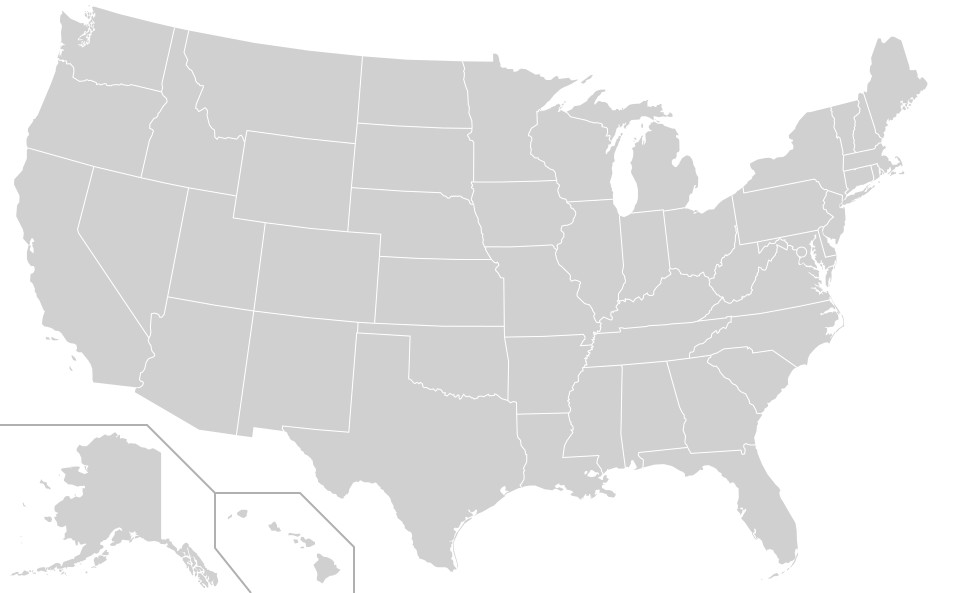
Location: Vancouver, WA
Farragut, Kenton, Ashley, Fircrest, Livingstone
Watch this project’s journey:
InstagramSee more on this project:
View the projectClick this market again for the next build here.
Your next step
New to development
A step-by-step challenge to line up your first deal, with our team beside you.
Join the ChallengeLive every week
Arthur and Ruben break down real deals and answer your questions in a live Q&A.
Join the live masterclassReady to build
Development consulting for people ready to put a real deal together now.
Explore consultingFree Resources
The templates, guides, and live sessions we hand every new member.
Real 2026 build costs for 43 US markets, from Arthur's own price map, with a live profit calculator.
Explore →Free PDFThe complete roadmap from land to sale, free.
Get it →Free AccessFree resources and every member story in one place.
Get it →Live WeeklyLive masterclass, weekly on Tuesdays. How to become a developer even with zero construction experience.
Get it →Free TemplateThe letter we use to reach lot owners directly, plus the training to use it.
Get it →Starter KitEverything you need to get moving on your first development, in one place.
Get it →Free CourseOur full 2.5-hour course on becoming a developer, land to exit, free on YouTube.
Get it →