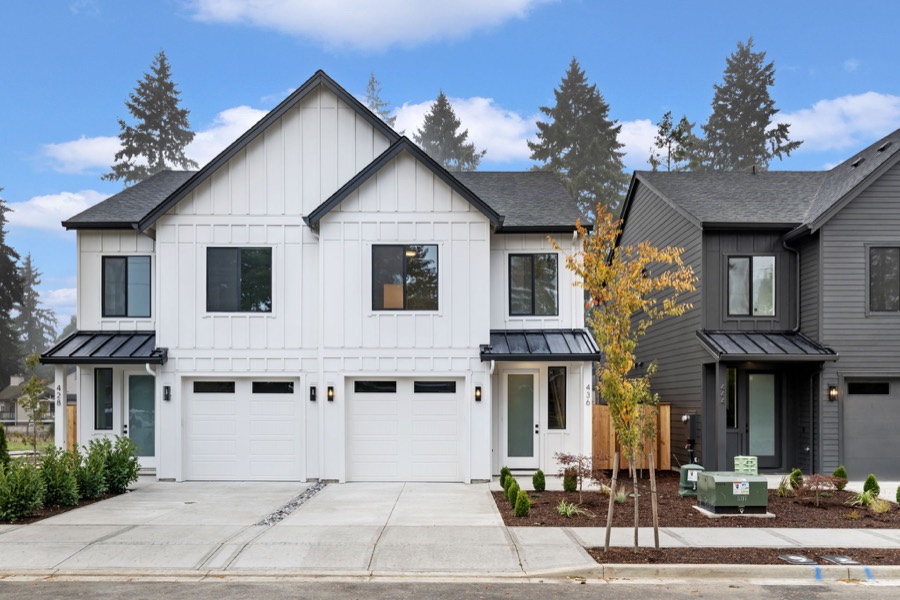
Arthur · 114 units
Location: Vancouver, WA
Farragut, Kenton, Ashley, Fircrest, Livingstone
Watch this project’s journey:
InstagramSee more on this project:
View the projectGetting Started · Arthur the Developer
Our 10-phase view of what a developer actually does, from reading a market to closing the sale, in one sitting.
Full guide: Getting Started →Real estate development is not skyscrapers and $50 million budgets. It is one single family home, or a duplex, or a sixplex on an infill lot. The difference between development and buying property is that you are not paying market price, you are creating the value at cost, and your margin is the gap. The process for a $300,000 build is identical to the process for a $3 million build, which is why learning it once scales forever. Here are all ten phases.
You do not need a license for this. Open a public listing portal, filter to new construction, and compare three numbers: active, pending, and sold in the last 90 days. The pending to active ratio is your demand gauge, and Arthur’s floor is about 30%. Then ask how long it would take to sell every active listing if all building stopped today. Three months of inventory is a hot market. Six months is slower but still workable if you budget more interest.
Then zoom into the pocket. If the street is all one story three bed two bath homes, that is what you build. If a river runs through it and the houses are $2 million, that is a different product entirely. Watch how fast correctly priced homes go pending: the right number goes contingent in a day, and a listing that drops $50,000 twice was overpriced by $100,000 from the start.
Two tests, in order. Buildable, then financial. Buildable means zoning and density (what can I build, and how many units), setbacks (draw the envelope: the front, side, and rear setbacks plus an 18 to 20 foot garage depth define your actual buildable box), and the three utilities of sewer, water, and power. Encroachments, easements, and environmental constraints are the deal killers to check for.
Financial is three buckets: land price, build cost, and sale price, and you calculate backward. Sale minus build minus land minus agent and closing costs equals your return, and the floor is 20%. Land should not exceed 20% of finished value. Worked example on a $500,000 home in Texas: $200,000 build, $100,000 land, a $20,000 builder fee, and $25,000 in closing at 5% of sale, which is $345,000 of cost against $500,000, so $155,000 of profit.
Every pocket has an edge feature that sells it. In the million dollar pocket it might be a three car garage, a primary suite on the first floor, and an oversized kitchen with a butler’s pantry. In the $300,000 townhome pocket, a two car garage instead of a one car garage is the differentiator. In the $750,000 pocket, an office on the first floor for someone working from home, or a main suite downstairs for guests.
Small units live or die on design. A 1,500 square foot, three bedroom townhome that is only 19 feet wide, about two cars side by side, can feel like 2,300 square feet if the great room, kitchen, and dining are laid out properly. Small spaces have to be designed deliberately to feel bigger than they are.
Hand a plan set to a drafter with no follow up and you will wait months, sometimes years. The sequence is: full plan set, structural engineering, site plan, corrections, submit. Every handoff is a place where weeks vanish.
So you ask for a date at every step and check in against it. Drafter says the 15th? Check in on the 7th and again on the 14th. Structural says the 30th? Check in on the 20th, 25th, and 29th, because otherwise you call on the 30th and hear it is still in the queue. When the architect says he submitted, email the city yourself to confirm they received it, because a plan set sitting in someone’s drafts folder costs you a month. Then ask the city for a target review date, and book your architect for the day after it.
Breaking ground without knowing your cost is a casino bet. Build a full line item budget, then get three bids per trade on identical scope, then sign contracts with every subcontractor through the builder. Line items run from permit fees, architecture, structural, survey, and geotech through excavation, foundation, lumber, trusses, windows, mechanical, electrical, plumbing, paint, and millwork.
A real example: a 3,000 square foot duplex. The pro forma carried $450,000 at $150 per square foot. Bid out, the budget came to $426,000 at $143 per foot. It landed at $403,000, about $136 per foot. Some lines went over, framing lumber came in $850 high, and some came under, garage basements estimated at $8,000 came in at $3,000, and landscaping dropped from $16,000 to $10,000 by using temporary sprinklers tied to a hose bib and pre-stained fencing. That gap between pro forma and actual is what a contingency is for.
This is the phase that separates developers who make it from developers who do not. Take a real triplex pro forma: a 30 by 126 foot lot, minus 10 foot setbacks, leaves a 20 foot wide building and 106 feet of depth, so three 35 foot units at 942 square feet each. Build at $170 per foot (conservative against a real $160), a 10% builder fee, land locked at $125,000, sale at $339,000 per unit, and the deal projects near 40% ROI.
The lender funds 90% loan to cost, so about $592,000, with 10% down at $65,000, an $8,800 loan fee, and closing costs. The critical detail is the draw schedule. You are charged interest only on money actually drawn. Pay $50,000 for excavation in month one and at 10% you owe about $417 that month, not interest on $592,000.
Three people matter: a builder, a lender, and an agent. The builder must be a spec builder with history, someone who buys land, builds, and sells for himself, because he understands cost, efficiency, and speed. A custom builder quotes $250 per foot on a build that costs $150 and keeps the difference. The lender must do 90% loan to cost on new construction and fund on draw. And the agent has to be one of the small minority who actually close volume, because most agents do not do a deal in a year and will tell you off market land does not exist.
One more thing a good lender does: if you buy land at $125,000, put $25,000 of permits into it, and it appraises at $200,000 when permit ready, that $50,000 of created equity counts toward your down payment. That is how a project gets done with very little cash in.
Never do the work. You are not the HVAC installer or the surveyor. You manage to three things: schedule, scope, and budget. Follow the schedule and push it. Define the scope precisely, because a clear scope means no change orders. And hold the budget by comparing every invoice against the contracts you signed, because the checkbook is your only real leverage. Genuine change orders happen, but they should stay inside 2.5% to 3% of the project.
Once you have done it once, you get obsessed with the only variable that really moves. You cannot sell a $1 million house for $1.5 million, and you cannot build for half price. But you can get land at a 50% discount, and Arthur has gotten land for free through a lot split. Land is the lever.
And when you sell, stage it. The average buyer does not have a developer’s imagination. For $500 to $1,500 you can furnish at least the primary bedroom and the main living area, kitchen, and dining, and the house will sell faster, for more, or both, because a space that feels tight empty feels generous furnished.
Ready to stop watching and start building?
Join the BuildUp Challenge and book a call with our team.
Join the BuildUp ChallengeWatch more on Arthur's channel.
Create value at cost instead of paying market price, and hire the professionals who execute. It is not skyscrapers and $50 million budgets. It can be one single family home, a duplex, or a sixplex on an infill lot. The process for a $300,000 build is the same as for a $3 million build.
Compare three numbers on new construction listings: active, pending, and sold in the last 90 days. A pending to active ratio around 30% or better signals demand. Then ask how long it would take to clear all active inventory if building stopped. Three months is hot, six months is slower but workable with more interest budgeted.
About nine out of ten. Roughly 90% fail on price, buildability, or market absorption. The one that survives should carry a 20% to 30% margin, and 20% ROI is the floor you never go below.
Taking a construction loan that charges interest on the full loan balance from day one instead of only on funds actually drawn. On a real triplex pro forma that mistake turns a $15,000 interest budget into roughly $50,000, which is enough to kill an otherwise good deal.
Schedule, scope, budget. Get three bids per trade on identical scope before breaking ground, sign contracts with every subcontractor through the builder, then compare every invoice against those contracts. The checkbook is your only real leverage, and legitimate change orders should stay inside 2.5% to 3% of project cost.
Nationwide
65+ active member builds, 300+ units in progress, across 20+ states. Click a market to see who is building there.
346
Units developing live
49
Markets

Location: Vancouver, WA
Farragut, Kenton, Ashley, Fircrest, Livingstone
Watch this project’s journey:
InstagramSee more on this project:
View the projectClick this market again for the next build here.
Your next step
New to development
A step-by-step challenge to line up your first deal, with our team beside you.
Join the ChallengeLive every week
Arthur and Ruben break down real deals and answer your questions in a live Q&A.
Join the live masterclassReady to build
Development consulting for people ready to put a real deal together now.
Explore consultingFree Resources
The templates, guides, and live sessions we hand every new member.
Real 2026 build costs for 43 US markets, from Arthur's own price map, with a live profit calculator.
Explore →Free PDFThe complete roadmap from land to sale, free.
Get it →Free AccessFree resources and every member story in one place.
Get it →Live WeeklyLive masterclass, weekly on Tuesdays. How to become a developer even with zero construction experience.
Get it →Free TemplateThe letter we use to reach lot owners directly, plus the training to use it.
Get it →Starter KitEverything you need to get moving on your first development, in one place.
Get it →Free CourseOur full 2.5-hour course on becoming a developer, land to exit, free on YouTube.
Get it →