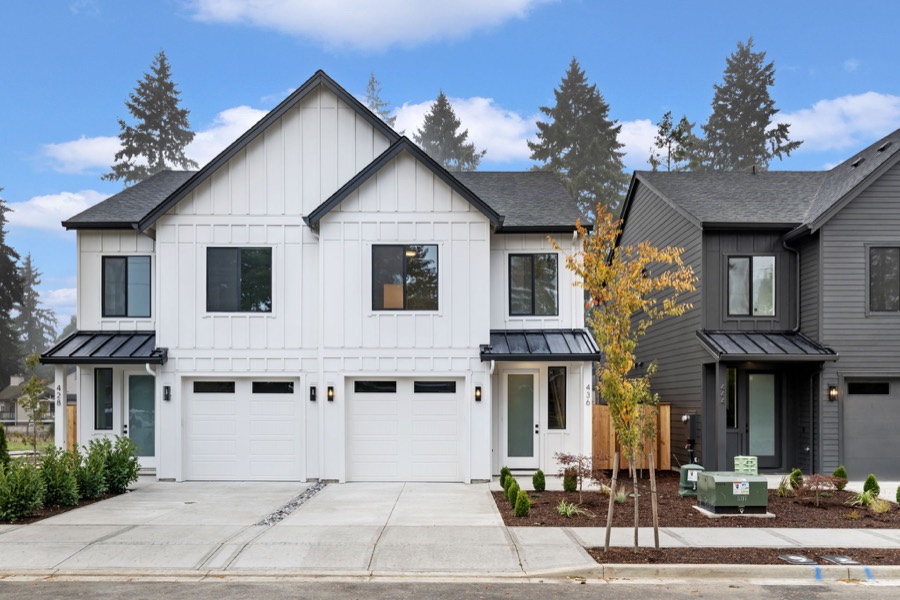
Arthur · 114 units
Location: Vancouver, WA
Farragut, Kenton, Ashley, Fircrest, Livingstone
Watch this project’s journey:
InstagramSee more on this project:
View the projectThe 7 Steps · Arthur the Developer
Step 2 of the series: how we underwrite a build so we know the number we can pay for the land before we ever tour it.
Full guide: The 7 Steps →Step 2 of the seven step series, and the one that decides everything. Underwriting a build runs backward: after build value first, then cost to build, then what is left over for the lot. Note that it is ABV, after build value, not ARV. ARV is a flip term. You are not repairing anything.
Before you can underwrite anything you have to know what you are building. Pull comps on bedroom and bathroom count, square footage, and lot size, and find the finished product that is actually selling. Worked example: the comp is $500,000 for a 2,000 square foot, 3 bed 2 bath home. Now you know the target.
Nationwide the working range is $125 to $200 per square foot for a spec home, meaning entry level construction with slightly nicer finishes if you want them. Not floating staircases. Real numbers we see: $160 to $170 in Oregon, Washington, and California, around $165 in northern Indiana, and $110 to $130 in Florida and Texas.
When a builder quotes $400 a square foot, that is a custom home builder, not a spec builder, unless you are genuinely building a $10 million house. On top of the construction number, add a builder fee of 10% to 15%. Arthur recommends hiring a builder rather than becoming one, unless you already hold a contractor license.
Take the $500,000 ABV. Build 2,000 square feet at $150 gives $300,000. Add a $30,000 builder fee and you are at $330,000. The land rule of thumb is 15% to 25% of the after build value, so at 20% the lot supports $100,000. That leaves about $70,000 of profit before financing costs, which is why Arthur would actually offer $75,000 for that lot rather than $100,000.
Three questions decide whether a lot is buildable at all. Is there sewer, and is it public or private? Is there water, and is it public or private? And how does power reach the property? If sewer is public you are generally required to connect to it, even if the main is 200 feet away, and you cannot substitute a septic tank. A lateral to a main running along the edge of the property might be $10,000. A real sewer extension because the main stops short of your lot is a different animal, and septic needs a lot large enough for a drain field. Crossing a street for power typically runs $3,000 to $8,000. Gas is optional, because an electric furnace and an electric water heater are always available.
The national call-before-you-dig service sends a locator out to field mark the existing lines. It is free, and crews typically show up within about three days.
They will tell you where sewer and water sit. They will not know power, because that belongs to the utility company, so call the power company directly and ask what it costs to reach your lot.
Search your county GIS or property information center. Most jurisdictions publish an interactive map where you can switch on sewer, water, and sometimes electrical or gas overlays.
The order matters. Numbers first, utilities second, zoning third. There is no point running a full zoning analysis on a lot with no sewer, water, or power. Once the first two clear, zoning tells you whether you are building a single family home, a duplex, or a fourplex, and that changes the whole model.
One more thing the utility research buys you: negotiating room. If you discover the sewer lateral costs $10,000, that is a documented $10,000 price reduction to ask the seller for.
Ready to stop watching and start building?
Join the BuildUp Challenge and book a call with our team.
Join the BuildUp ChallengeWatch more on Arthur's channel.
Backward. Start with after build value from comps, subtract cost to build plus the builder fee, and whatever is left is what you can pay for the lot. Note it is ABV, after build value, not ARV. ARV is a flip term and you are not repairing anything.
Between $125 and $200 per square foot for a spec home, depending on the market. We see $160 to $170 in Oregon, Washington, and California, around $165 in northern Indiana, and $110 to $130 in Florida and Texas. A quote near $400 a square foot is a custom home builder, not a spec builder.
15% to 25% of the after build value as a rule of thumb. On a $500,000 finished home that is about $100,000 at 20%. Treat it as the number you make an offer with, not the answer. The real number comes from working backward from value minus build cost minus builder fee.
Three ways. Call 811 and a locator field marks the existing lines for free, usually within about three days. Call the city or county for sewer and water, then call the power company separately because power is not their jurisdiction. And open your county GIS or property information center map and switch on the utility overlays.
A sewer lateral to a main running along the property edge can be around $10,000. A full sewer extension because the main stops short of your lot is far more, and septic requires a lot big enough for a drain field. Bringing power across a street typically runs $3,000 to $8,000. Every one of those costs is a price reduction to ask the seller for.
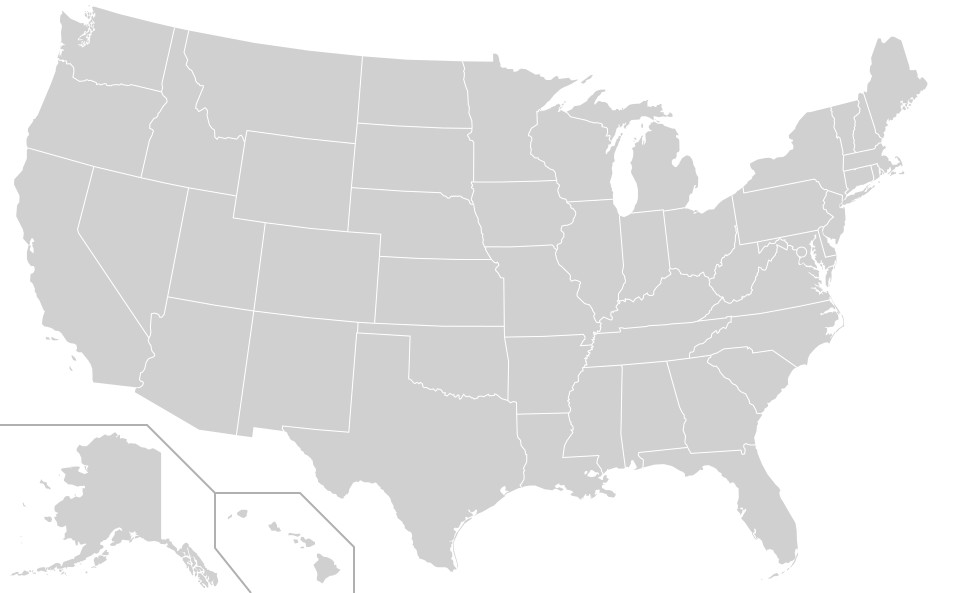
Nationwide
65+ active member builds, 300+ units in progress, across 20+ states. Click a market to see who is building there.
346
Units developing live
49
Markets
Location: Vancouver, WA
Farragut, Kenton, Ashley, Fircrest, Livingstone
Watch this project’s journey:
InstagramSee more on this project:
View the projectClick this market again for the next build here.
Your next step
New to development
A step-by-step challenge to line up your first deal, with our team beside you.
Join the ChallengeLive every week
Arthur and Ruben break down real deals and answer your questions in a live Q&A.
Join the live masterclassReady to build
Development consulting for people ready to put a real deal together now.
Explore consultingFree Resources
The templates, guides, and live sessions we hand every new member.
Real 2026 build costs for 43 US markets, from Arthur's own price map, with a live profit calculator.
Explore →Free PDFThe complete roadmap from land to sale, free.
Get it →Free AccessFree resources and every member story in one place.
Get it →Live WeeklyLive masterclass, weekly on Tuesdays. How to become a developer even with zero construction experience.
Get it →Free TemplateThe letter we use to reach lot owners directly, plus the training to use it.
Get it →Starter KitEverything you need to get moving on your first development, in one place.
Get it →Free CourseOur full 2.5-hour course on becoming a developer, land to exit, free on YouTube.
Get it →